Best Scientific Books Of All Time Classics
- 1.
What Makes a Scientific Book Timeless?
- 2.
From Principia to Pop Science: The Evolution of Scientific Storytelling
- 3.
Why “On the Origin of Species” Still Gives Us Chills
- 4.
Einstein’s Relativity: Not Just for Physicists Anymore
- 5.
Carl Sagan’s “Cosmos”: Where Science Meets Soul
- 6.
Richard Dawkins and the Gene’s-Eye View of Life
- 7.
Stephen Hawking’s “A Brief History of Time”: Selling Millions Without Being Read
- 8.
“Guns, Germs, and Steel”: Science Meets Human History
- 9.
The Role of Women in Shaping Scientific Literature
- 10.
Beyond the Canon: Hidden Gems and Future Classics
Table of Contents
best scientific books of all time
What Makes a Scientific Book Timeless?
Ever cracked open a dusty old tome only to realize the universe just whispered its secrets into your ear? That, friends, is the magic of the best scientific books of all time. These ain’t your average textbooks—they’re cosmic love letters, intellectual grenades, and sometimes, quiet revolutions wrapped in paper. What separates the forgettable from the forever? It’s not just raw data or elegant equations; it’s how a book bends the arc of human thought. The best scientific books of all time don’t just inform—they transform. They haunt grad students at 3 a.m., inspire garage tinkerers, and make philosophers nod like they’ve just heard God clear his throat.
Timelessness in science writing comes from clarity, vision, and a dash of poetic madness. Think: Darwin didn’t just describe finches—he rewrote our origin story. Einstein didn’t just scribble E=mc²—he gave us a new grammar for reality. That’s the gold standard for the best scientific books of all time.
From Principia to Pop Science: The Evolution of Scientific Storytelling
Back in 1687, Isaac Newton dropped Philosophiæ Naturalis Principia Mathematica like it was hot—and let’s be real, nobody read it for fun. Written in Latin and packed with geometry so dense it could crush a Kindle, it was the OG of the best scientific books of all time. Fast-forward to today, and you’ve got authors like Carl Sagan or Neil deGrasse Tyson turning astrophysics into bedtime stories for grown-ups. Ain’t that something?
The shift from formal treatises to pop science wasn’t just about dumbing things down—it was about democratizing wonder. Now, whether you’re sippin’ sweet tea in Georgia or waitin’ for the subway in Brooklyn, you can grasp quantum weirdness without a PhD. That accessibility? That’s what keeps the best scientific books of all time alive across generations. They don’t gatekeep knowledge—they fling the gates wide open and yell, “Y’all come on in!”
Why “On the Origin of Species” Still Gives Us Chills
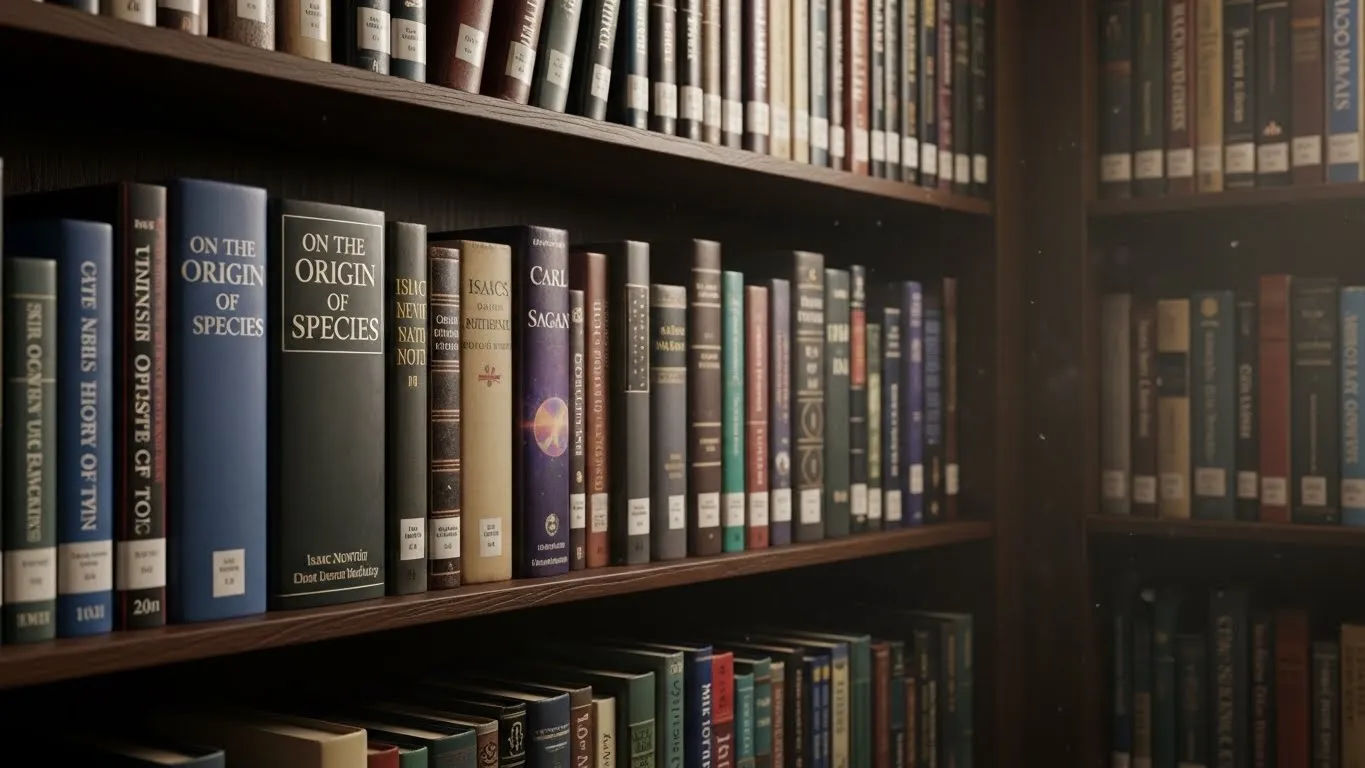
Let’s talk about Charles Darwin. Dude sailed on a boat, watched birds, and somehow ended up shaking the pillars of Western thought like a snow globe. On the Origin of Species (1859) didn’t just propose evolution—it weaponized observation. And honestly? It reads like a detective novel if the culprit was life itself.
Even today, the best scientific books of all time list ain’t complete without Darwin’s masterpiece. It’s not just “science”—it’s narrative brilliance. He didn’t shout his theory; he whispered it through barnacles, pigeon breeds, and island ecosystems. Teachers still assign it, skeptics still sweat over it, and biologists still quote it like scripture. That’s legacy, baby. That’s the best scientific books of all time doing what they do best: making us question who we are and where we came from—without once mentioning God (but also not denying Him, which was slick).
Einstein’s Relativity: Not Just for Physicists Anymore
Albert Einstein’s Relativity: The Special and the General Theory (1916) was his attempt to explain his own genius to the rest of us mere mortals. And guess what? He mostly pulled it off. Written with minimal math and maximum mind-bends, it’s one of those best scientific books of all time that actually invites you to the party instead of making you stand outside in the rain.
What’s wild is how Einstein used thought experiments—riding light beams, falling elevators—to make spacetime feel tangible. You don’t need a lab coat; you just need imagination. That’s why this book remains a cornerstone of the best scientific books of all time. It proves science ain’t just about answers—it’s about asking questions so beautiful they ache.
Carl Sagan’s “Cosmos”: Where Science Meets Soul
If the best scientific books of all time had a heart, it’d beat to the rhythm of Carl Sagan’s Cosmos. Published in 1980 as a companion to the TV series, this book doesn’t just teach astronomy—it serenades it. Sagan writes like he’s gazing at the Milky Way from a hill in upstate New York, whisperin’, “Y’all are made of starstuff, don’t you forget it.”
There’s poetry in his prose, urgency in his warnings about nuclear war, and reverence in every paragraph. Cosmos reminds us that science isn’t cold—it’s deeply human. And that’s why it’s cemented as one of the best scientific books of all time. It doesn’t just fill your brain; it fills your chest with wonder.
Richard Dawkins and the Gene’s-Eye View of Life
When Richard Dawkins dropped The Selfish Gene in 1976, biologists didn’t just take notes—they rewrote their lectures. The book flipped evolution on its head by arguing that genes, not organisms, are the real players in natural selection. Sounds cold? Maybe. But it’s also brilliantly clarifying.
Dawkins writes with the precision of a surgeon and the flair of a stand-up comic. He even coined the term “meme” here—long before TikTok made it mainstream. That’s the power of the best scientific books of all time: they invent language, shape culture, and stick around like that one uncle who shows up at every family reunion with wild theories about aliens.
Stephen Hawking’s “A Brief History of Time”: Selling Millions Without Being Read
Let’s be real—how many of us actually finished A Brief History of Time? Doesn’t matter. The fact that Stephen Hawking got millions of people to buy a book about black holes, imaginary time, and the no-boundary proposal is a miracle in itself. Published in 1988, it became the poster child for “smart coffee table decor.”
But dig deeper, and you’ll find Hawking’s genius: he made cosmology feel intimate. He talked about the Big Bang like it was a campfire story. And yeah, you might zone out during the part about quantum gravity, but you’ll remember his line: “Look up at the stars, not down at your feet.” That’s the magic of this entry in the best scientific books of all time—it inspires more than it instructs, and sometimes, that’s enough.
“Guns, Germs, and Steel”: Science Meets Human History
Jared Diamond’s Guns, Germs, and Steel (1997) ain’t pure science—it’s a cross-genre jam session between biology, geography, and anthropology. But it belongs on any list of the best scientific books of all time because it answers a question most folks are too scared to ask: Why did some societies dominate others?
Diamond argues it wasn’t race or intelligence—it was wheat, cows, and continental orientation. Sounds wild, right? But his evidence is airtight. The book won a Pulitzer, pissed off more than a few academics, and became required reading in high schools from Seattle to Savannah. That’s impact. That’s the best scientific books of all time doing sociology with a lab coat on.
The Role of Women in Shaping Scientific Literature
Let’s not pretend the canon of the best scientific books of all time isn’t dominated by dudes in bow ties. But women? They’ve been writing groundbreaking science forever—even when the door was shut. Take Rachel Carson’s Silent Spring (1962). This book didn’t just expose pesticide dangers; it sparked the modern environmental movement.
Carson wrote with lyrical urgency, comparing poisoned rivers to “a town without birdsong.” Her work led to the banning of DDT and the creation of the EPA. And she did it while battling cancer. If that ain’t heroism wrapped in the best scientific books of all time, I don’t know what is. We’re still playing catch-up in recognizing voices like hers—but the tide’s turning, slow and sure.
Beyond the Canon: Hidden Gems and Future Classics
Not every gem makes the “best of” lists—but some deserve a standing ovation anyway. Books like The Emperor of All Maladies by Siddhartha Mukherjee (a biography of cancer), or Sapiens by Yuval Noah Harari (a wild ride through human history), blur the line between science and storytelling so beautifully, they should be required reading.
And hey, if you’re hunting for the next generation of the best scientific books of all time, keep an eye on authors like Ed Yong (An Immense World) or Janna Levin (Black Hole Blues). They’re writing science like it’s a campfire tale for the Anthropocene. For more deep dives, swing by the Onomy Science homepage, browse the Books category, or check out our full guide to Best Scientific Non Fiction Books Essentials. Trust us—you’ll thank us later.
Frequently Asked Questions
What was the greatest scientific book ever written?
Many scholars point to Isaac Newton’s Philosophiæ Naturalis Principia Mathematica as the greatest scientific book ever written. It laid the foundation for classical mechanics and introduced the laws of motion and universal gravitation. Its mathematical rigor and revolutionary impact make it a cornerstone of the best scientific books of all time.
What is the best book to read about science?
For beginners and lifelong learners alike, Carl Sagan’s Cosmos is often hailed as the best book to read about science. It blends astronomy, history, and philosophy with poetic prose, making the universe feel both vast and deeply personal. It’s a definitive entry in the best scientific books of all time for its accessibility and emotional resonance.
What are the top 10 science fiction books of all time?
While science fiction is distinct from scientific non-fiction, classics like Dune by Frank Herbert, Foundation by Isaac Asimov, and Neuromancer by William Gibson dominate those lists. However, when discussing the best scientific books of all time, we focus on non-fiction works that shaped real-world understanding—like Darwin’s Origin of Species or Einstein’s Relativity.
What is the #1 book of all time?
The “#1 book of all time” depends on genre and criteria—but in scientific literature, On the Origin of Species by Charles Darwin frequently tops expert polls. Its blend of evidence, narrative, and paradigm-shifting insight secures its place as the pinnacle of the best scientific books of all time.
References
- https://www.britannica.com/science/Principia-Mathematica
- https://www.nobelprize.org/prizes/themes/einsteins-annus-mirabilis-papers-1905
- https://www.pulitzer.org/winners/jared-diamond
- https://www.cdc.gov/history/biographies/rachel-carson.htm