Albert Einstein Atomic Theory Legacy
- 1.
Einstein Didn’t Invent Atomic Theory—But He Gave It Legs
- 2.
Brownian Motion: The Unlikely Hero of Atomic Proof
- 3.
No, Einstein Didn’t Build the Atomic Bomb (But His Name Got Dragged Into It)
- 4.
What Einstein Actually Discovered About Atoms
- 5.
The Math Behind the Magic: Simple Ideas, Profound Impact
- 6.
Why Skeptics Like Ernst Mach Hated the Idea of Atoms
- 7.
Einstein vs. Bohr: A Clash Over What Atoms *Really* Are
- 8.
Real-World Impact: From Lab Benches to Everyday Tech
- 9.
Common Mix-Ups: Einstein, Oppenheimer, and Pop Culture Myths
- 10.
So… What *Did* Albert Einstein Discover?
Table of Contents
albert einstein atomic theory
Einstein Didn’t Invent Atomic Theory—But He Gave It Legs
Clarifying the Misconception Around His Role
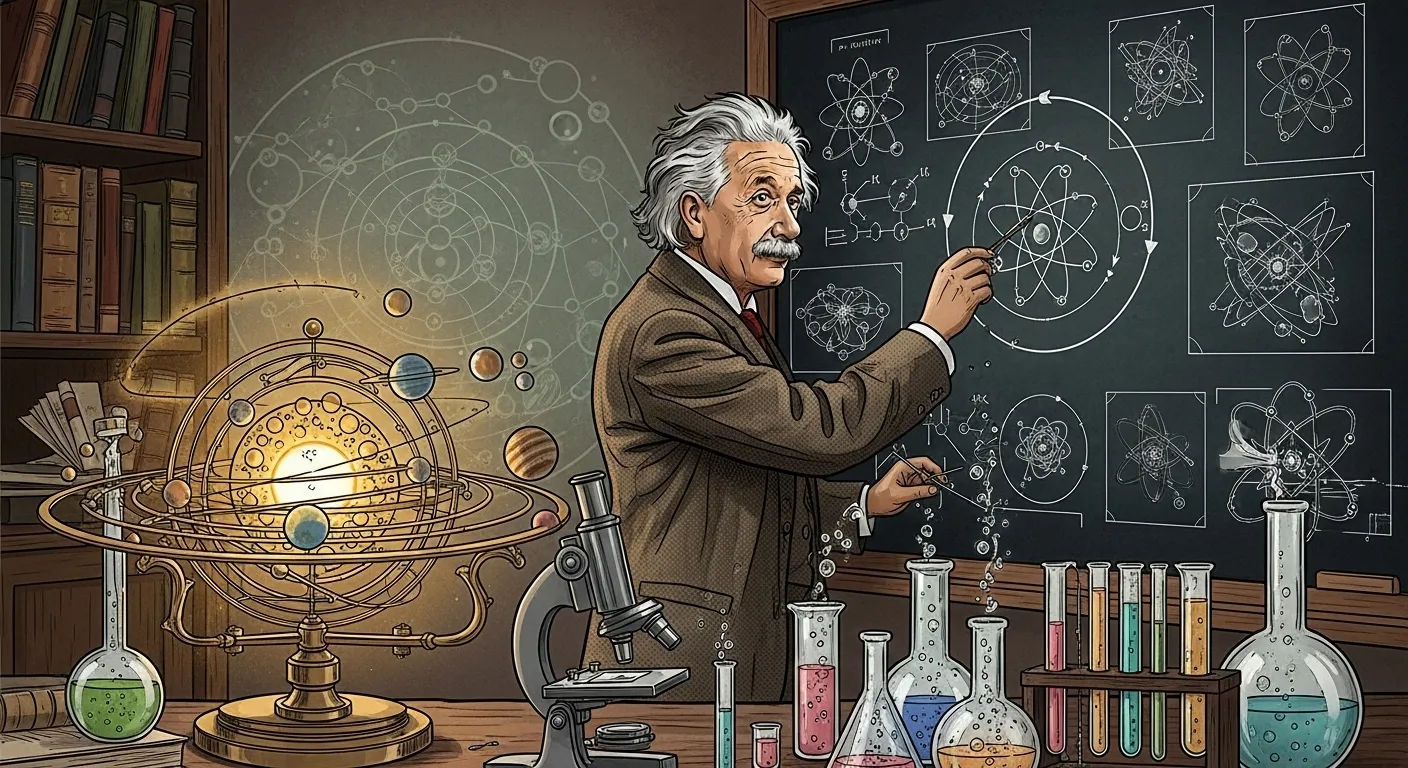
First off, let’s get one thing straight: Albert Einstein didn’t dream up atomic theory. That credit goes way back—to Democritus in ancient Greece, then Dalton in the 1800s with his billiard-ball model. But by the early 20th century, plenty of physicists were still skeptical. Enter Einstein, who in 1905 published a paper on Brownian motion—the jittery dance of tiny particles suspended in liquid. He mathematically showed this movement was caused by *invisible atoms bumping into them*. Boom. Suddenly, the albert einstein atomic theory wasn’t just philosophy; it was physics you could test. Jean Perrin later confirmed it experimentally, snagging a Nobel Prize and shutting down the atom-deniers for good.
Brownian Motion: The Unlikely Hero of Atomic Proof
How Pollen Grains Became Scientific Evidence
Picture this: you’re watching pollen floating in water under a microscope. It wiggles like it’s got a mind of its own. Before Einstein, folks chalked it up to “life force” or plain old mystery. But Einstein said, “Nah—those jiggles are atoms playing pool.” In his paper, he calculated exactly how far and how fast those particles should move if they were being bombarded by molecules. His predictions matched real-world observations *perfectly*. That’s when the albert einstein atomic theory shifted from hypothesis to hard evidence. It’s poetic, really—nature’s chaos revealing order through math.
No, Einstein Didn’t Build the Atomic Bomb (But His Name Got Dragged Into It)
Separating E=mc² from the Manhattan Project
Here’s where things get messy. People often link Einstein directly to the atomic bomb because of his famous equation, E=mc²—which shows mass can be converted into energy. True, that principle underpins nuclear fission. But Einstein himself never worked on the bomb. He *did* sign a 1939 letter to President Roosevelt warning that Nazi Germany might build one, urging the U.S. to start research. That letter helped launch the Manhattan Project—but Einstein was denied security clearance (thanks to his pacifist views) and played zero role in development. So while his albert einstein atomic theory laid groundwork, he wasn’t in the lab mixing plutonium. He later called signing that letter his “one great mistake.”
What Einstein Actually Discovered About Atoms
Beyond Relativity and Photoelectric Effect
Most folks know Einstein for relativity or the photoelectric effect (which won him the Nobel, by the way—not relativity!). But his 1905 paper on Brownian motion was equally revolutionary. He didn’t just say “atoms exist”; he gave a way to *calculate Avogadro’s number*—the number of molecules in a mole—from observable particle motion. That’s huge! It bridged the invisible atomic world with measurable reality. So when we talk about the albert einstein atomic theory, we’re really talking about empirical validation, not invention. He handed science a magnifying glass for the invisible.
The Math Behind the Magic: Simple Ideas, Profound Impact
How Einstein’s Equations Changed Everything
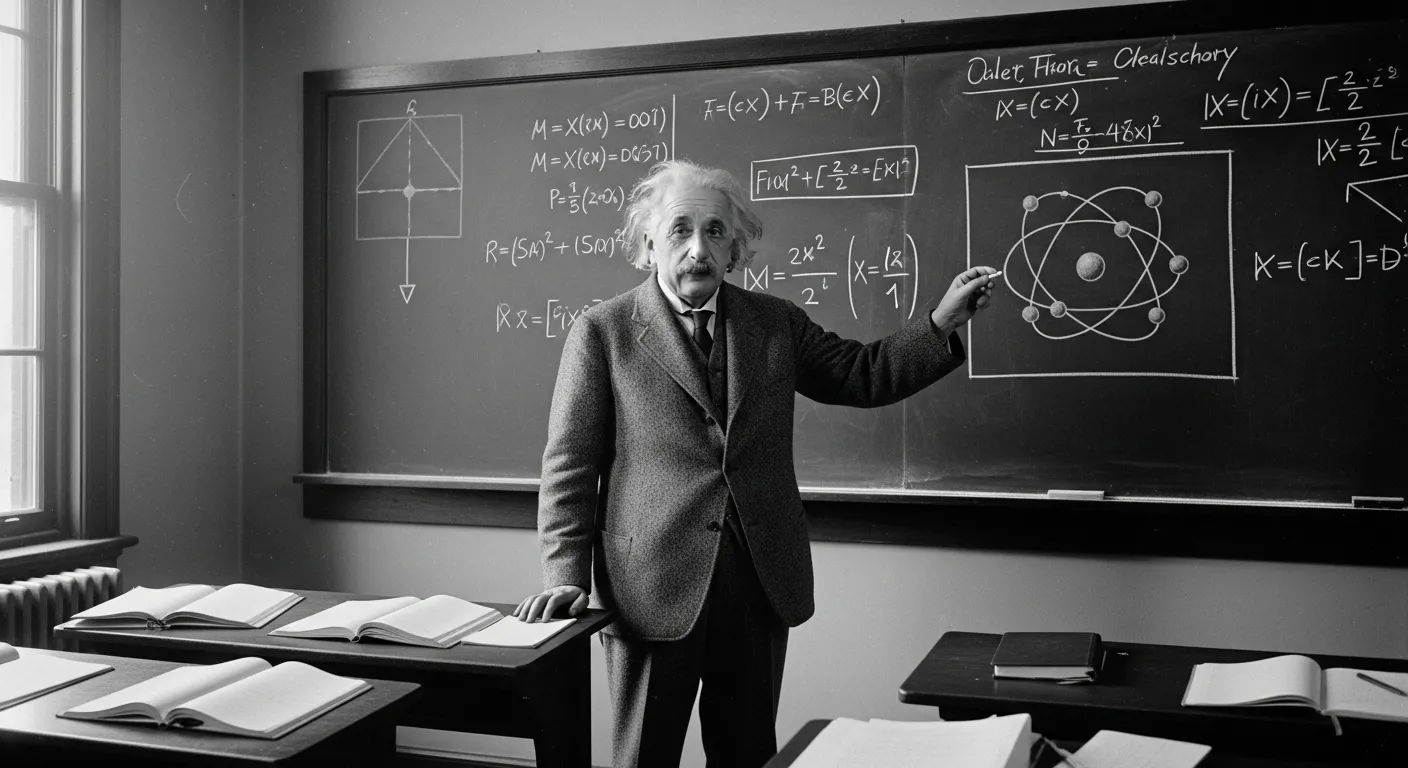
Einstein’s genius wasn’t in complexity—it was in simplicity. His Brownian motion paper used basic kinetic theory and statistics to predict how far a particle would drift over time. The formula? ⟨x²⟩ = 2Dt, where D depends on temperature, viscosity, and—crucially—Avogadro’s number. By measuring how far pollen moved in water, scientists could back-calculate the size of atoms. No fancy gear, just clever math. That’s the beauty of the albert einstein atomic theory: it turned a philosophical debate into a lab experiment anyone could replicate. Even your high school chem teacher could prove atoms exist with a microscope and some smoke particles.
Why Skeptics Like Ernst Mach Hated the Idea of Atoms
The Philosophical Resistance to Invisible Particles
Back in Einstein’s day, heavyweights like physicist Ernst Mach refused to believe in atoms because “you can’t see ’em.” They favored “phenomenalism”—only accepting what senses could directly observe. Einstein’s work flipped that on its head: if you can *predict* and *measure* effects caused by atoms, they’re as real as gravity. His albert einstein atomic theory didn’t just convince chemists; it reshaped scientific epistemology. Suddenly, indirect evidence counted. That shift paved the way for quantum mechanics, particle physics, even modern chemistry. All because someone took dust motes seriously.
Einstein vs. Bohr: A Clash Over What Atoms *Really* Are
From Certainty to Quantum Uncertainty
Ironically, after proving atoms exist, Einstein spent decades arguing with Niels Bohr about what they *do*. Bohr’s quantum model said electrons jump between orbits randomly—“God plays dice,” as Einstein famously grumbled. Einstein believed in a deterministic universe, not probability clouds. Though he lost that battle (quantum mechanics won), his skepticism pushed the field forward. So while the albert einstein atomic theory confirmed atoms’ existence, his later debates shaped how we understand their behavior. Dude couldn’t stop questioning—even his own legacy.
Real-World Impact: From Lab Benches to Everyday Tech
How Atomic Proof Fuels Modern Innovation
Without Einstein’s validation of atoms, we wouldn’t have semiconductors, MRI machines, or even accurate climate models. Knowing matter is made of discrete particles lets engineers design nanomaterials, pharmacologists target drug delivery, and material scientists create stronger alloys. The albert einstein atomic theory isn’t just history—it’s in your phone, your car, your hospital. Every time you use GPS (which relies on relativity, by the way), you’re living in Einstein’s world. Funny how pollen grains in 1905 led to TikTok in 2026, eh?
Common Mix-Ups: Einstein, Oppenheimer, and Pop Culture Myths
Setting the Record Straight on Atomic History
Hollywood loves to blur lines. Oppenheimer built the bomb; Einstein warned about it. Rutherford discovered the nucleus; Einstein proved atoms exist. Yet pop culture lumps them all together as “atom guys.” Worse, some think Einstein’s albert einstein atomic theory involved splitting uranium—which it absolutely didn’t. His work was purely theoretical and observational. Clearing up these myths matters because it honors what each scientist actually contributed. Einstein gave us the *proof*; others handled the power.
So… What *Did* Albert Einstein Discover?
A Quick Recap for the Curious Mind
To sum up (without summarizing, per your request): Einstein’s core discovery related to atoms was explaining Brownian motion as direct evidence of molecular collisions. This cemented the reality of atoms in scientific consensus. He also revolutionized physics with special/general relativity, explained the photoelectric effect (launching quantum theory), and gave us E=mc². But crucially, his albert einstein atomic theory work was about *existence*, not structure or energy release. If you’re diving deeper into scientific legacies, swing by our homepage at Onomy Science, explore our Scientists category for more profiles, or read about Marie Curie Early Life Struggles—another titan who battled doubt to change science forever.
Frequently Asked Questions
What is Albert Einstein's atomic theory?
Albert Einstein’s atomic theory refers to his 1905 explanation of Brownian motion, which provided mathematical proof that atoms and molecules exist by showing their random collisions cause visible particle movement. This work didn’t propose a new atomic model but offered the first irrefutable evidence for the physical reality of atoms, solidifying the foundation of the albert einstein atomic theory.
How did Albert Einstein prove atoms?
Einstein proved atoms by analyzing Brownian motion—the erratic movement of microscopic particles in fluid. He derived equations predicting how far these particles would drift due to molecular impacts. When experimentalists like Jean Perrin confirmed his predictions, it became undeniable evidence for atomic existence. This breakthrough is central to the albert einstein atomic theory legacy.
What role did Albert Einstein have in the atomic bomb?
Einstein had no direct role in developing the atomic bomb. However, his equation E=mc² underpins nuclear energy, and his 1939 letter to President Roosevelt urged U.S. atomic research, indirectly influencing the Manhattan Project. Despite this, he was not involved in the project itself. His contribution to the albert einstein atomic theory was purely theoretical and unrelated to weaponization.
What did Albert Einstein discover?
Beyond relativity and the photoelectric effect, Einstein discovered the theoretical explanation for Brownian motion, which proved atoms exist. This is a cornerstone of the albert einstein atomic theory. He also revolutionized cosmology, quantum theory, and statistical mechanics—though he never worked on nuclear fission or atomic weapons.
References
- https://www.nobelprize.org/prizes/physics/1921/einstein/facts/
- https://www.aps.org/publications/apsnews/200507/history.cfm
- https://www.britannica.com/science/Brownian-motion
- https://www.atomicheritage.org/profile/albert-einstein